Is Kids MMA Safe? What Parents Should Know About Jiu-Jitsu and Kickboxing
When parents hear the words “kids MMA,” it is completely normal for them to pause.
They picture adults fighting on TV. They picture hard punches, knockouts, blood, and chaos. They wonder if the training is too rough, too aggressive, or simply inappropriate for a child.
As a parent, I understand that reaction. As a coach, I think it is a fair question.
So let’s answer it honestly.
Kids MMA at Union Martial Arts is not UFC for kids.
But kids are learning the same skills that high-level martial artists use: Boxing, Kickboxing, Jiu-Jitsu, Wrestling, and MMA. The difference is how those skills are taught, structured, supervised, and developed over time.
At Union, we train kids in structured Kickboxing, Jiu-Jitsu, and age-appropriate MMA from the ages of 5 and up. Our job is to create the opposite of chaos. Our job is to help kids build real skill, confidence, discipline, grit, and self-control in a safe and serious training environment.
The Biggest Fear: Head Trauma
The first concern most parents have is head trauma.
That is a fair concern.
Any sport or physical activity carries some level of risk. Soccer, football, basketball, wrestling, gymnastics, cheer, skateboarding, and martial arts all involve movement, contact, falling, collisions, and the possibility of injury.
The real question is not whether risk exists. It does.
The better question is: how is the training being run?
At Union Martial Arts, kids are not thrown into a free-for-all. We do not encourage or allow reckless sparring. We do not build a culture around toughness at the expense of safety or skill.
We build a culture around learning, technique and control.
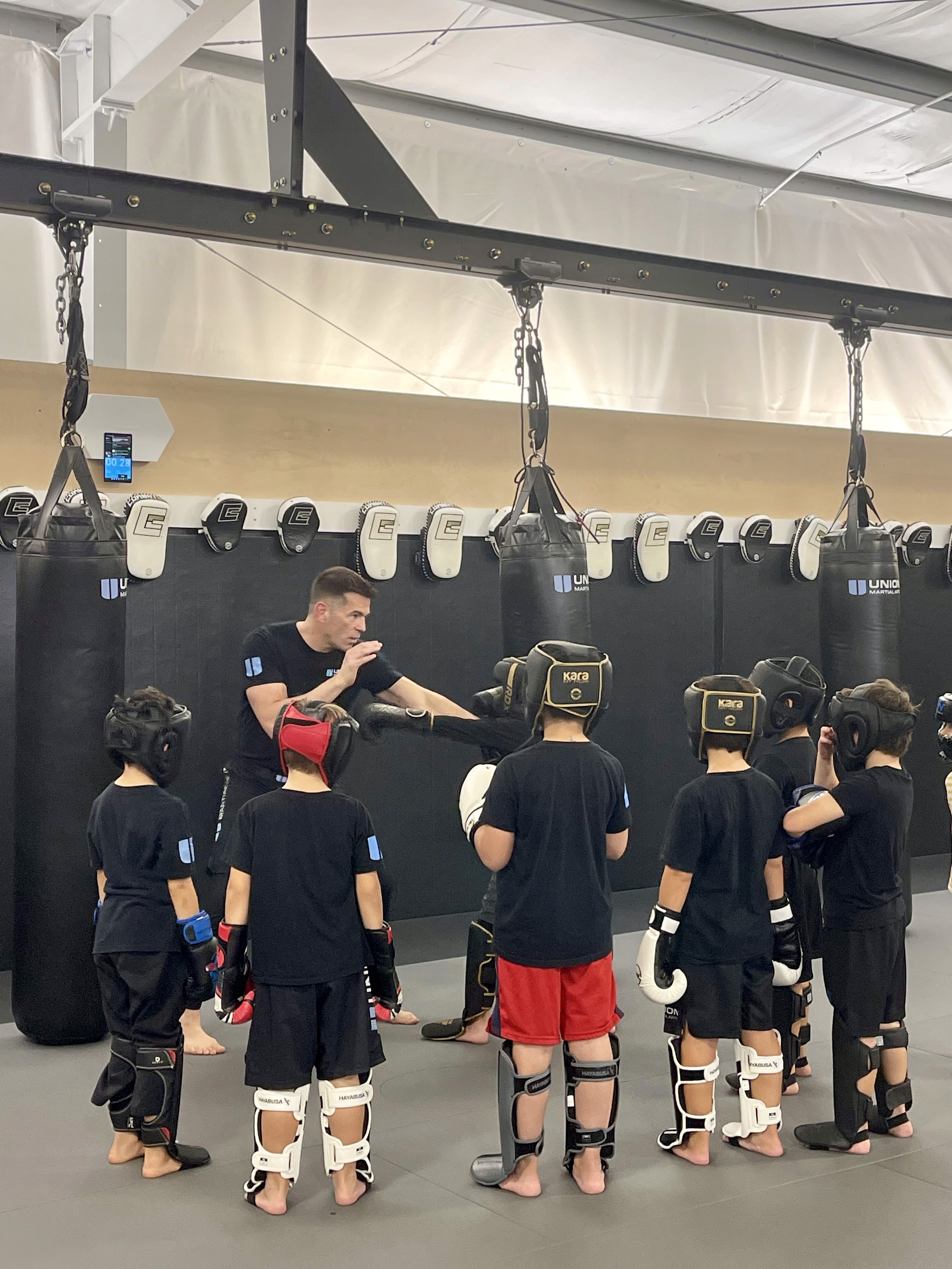
In our kids Kickboxing and MMA classes, sparring is controlled. The goal is to build skill, timing, distance, defense, footwork, and confidence. We teach kids to go light and technical so they can actually learn. A child who is tense, scared, or overwhelmed is not learning well. A child who is trying to “win” every exchange by going hard is missing the point of training.
We also require appropriate protective gear for kids who spar in Kickboxing and MMA: headgear, mouthguard, gloves, and shin guards.
For Kids Jiu-Jitsu, ear guards are mandatory.
That does not mean bumps, bruises, and mistakes can never happen. This is physical training. But it does mean the class is supervised, structured, and guided by coaches who are paying attention to intensity, partner selection, and the purpose of the drill.
Kids Are Grouped by Age, Size, Experience, and Readiness
One of the most important parts of kids martial arts training is knowing who should work with whom.
At Union, we split the room into groups based on age and experience. Typically, that means ages 5 to 7 in one group and ages 8 and up in another, with kids partnered appropriately based on their size, experience, maturity, and ability.
A brand-new 5-year-old should not be trained the same way as a confident 10-year-old.
A careful beginner should not be treated the same way as a child who has already spent years learning how to move, listen, drill, spar, and take coaching.
Around age 12, depending on the student, we often begin moving older kids into the adult program where they can train with other young teens. That transition is not just about age. It is about readiness.
Kids develop at different speeds. Some need more confidence. Some need more discipline. Some need more structure. Some need more challenge. Some need to be slowed down. Some need to be pushed forward.
Coach Nolan has been teaching for the past 19 years and has developed a wide range of methods and approaches to help reach different children, abilities, and personalities.
That experience has shaped the way we design classes at Union.
What Kids Actually Learn in Kickboxing
Kickboxing gives kids a foundation in striking.
They learn stance, balance, footwork, punches, kicks, defense, timing, distance, and movement. They learn how to strike, block, evade, counter, and control a standing situation while under pressure.
That last part is essential.
A child who learns Kickboxing properly is not just learning how to hit. They are learning when not to hit. They are learning to listen, control their emotions, follow rules, respect partners, and understand boundaries.
That is the opposite of reckless aggression.
What Kids Learn in Jiu-Jitsu
Jiu-Jitsu gives kids a foundation in grappling and the fundamentals of wrestling.
They learn takedowns, control positions, escapes, pins, guard passing, guard retention, sweeps, submissions, and submission defense. They learn how to stay calm when another person is physically resisting them.
That is one of the most valuable parts of Jiu-Jitsu.
Most sports teach effort, teamwork, conditioning, and competition. Those are all good things. But Jiu-Jitsu teaches a child how to solve a physical problem in real time against another person who is trying to stop them.
That is a different kind of confidence.
A child learns: “I can be uncomfortable and still think. I can be tired and still work. I can be stuck and still find a way out.”
That confidence carries far beyond the mat.
What Kids MMA Means at Union
MMA simply means mixed martial arts.
At Union, Kids MMA means we help students understand how striking, wrestling, and Jiu-Jitsu connect.
They learn how to move on their feet and strike. They learn how to defend themselves. They learn how to take someone down safely and strike while on the ground. They learn how to get back up. They learn how to control positions. They learn how to escape. They learn how to submit and how to defend submissions.
But they are not doing adult MMA.
They are learning age-appropriate MMA skills in a coached environment.
There is a big difference.
Drilling, Games, and Live Training
We believe in a variety of methods.
Kids need technical drilling. They need clear instruction. They need repetition. They need to learn what a movement is supposed to feel like.
They also need constraint-led games. These are training games with specific rules and goals. Instead of giving a child a long lecture, we put them in a situation where they have to solve a problem.
Can you escape this position?
Can you hold this position?
Can you keep your balance?
Can you get back to your feet?
Can you defend without panicking?
Can you control your partner without hurting them?
We also believe in live sparring and live training. Ultimately, real skill has to work against a fully resisting opponent. That does not mean reckless intensity. It means kids need to test what they are learning in a supervised, age-appropriate way.
That is where confidence becomes real.
How Does Martial Arts Compare to Other Youth Sports?
Research on martial arts injuries is not as simple as people sometimes make it sound.
Research on youth sports injuries has generally shown martial arts to compare favorably with many popular contact and team sports. That does not mean injuries cannot happen. They can. But it does challenge the assumption that martial arts training is automatically more dangerous than sports like football, soccer, basketball, wrestling, gymnastics, or cheer.
The structure of the class changes the risk.
Good coaching, proper gear, smart partner selection, controlled intensity, age-appropriate training, and a strong culture make all the difference.
At Union, that is exactly what we are trying to build.
Will Martial Arts Make My Child More Aggressive?
This is another common concern.
Parents worry that if their child learns Kickboxing, Jiu-Jitsu, or MMA, they may become rougher, more aggressive, or more likely to fight.
In a poorly run environment, that concern may be valid.
But in a well-run martial arts school, the opposite is usually true.
Kids learn rules. They learn boundaries. They learn respect. They learn that strength without control is a problem. They learn that training partners are not enemies. They learn that the goal is not to hurt someone. The goal is to develop skill.
Many parents have told us this directly through their Google reviews, and we are very proud of that.
Parents often come in hoping their child will become more confident, more focused, and more disciplined. Over time, they see their child become calmer, more respectful, more willing to work through challenges, and more capable of handling pressure.
That is the real value of martial arts.
What use is training if a child is not also learning focus, discipline, humility, perseverance, grit, and consistency?
We are proud of the quality of the martial arts we teach. We are just as proud of the values and environment we lead kids through every week.
The Skills Kids Walk Away With
The physical skills are obvious.
Kids learn how to punch, kick, wrestle, grapple, escape, control, submit, defend, and move better.
But the deeper skills are even more valuable.
They learn how to stay calm under pressure.
They learn how to solve problems in real time.
They learn how to be assertive without being aggressive.
They learn how to handle frustration.
They learn how to lose, reset, and try again.
They learn how to work with different partners.
They learn how to control their body.
They learn how to keep going when something is hard.
Those are life skills.
And those are the qualities parents are usually looking for in the first place.
Come See It for Yourself
If you are nervous about Kids MMA, Kickboxing, or Jiu-Jitsu, that is completely understandable.
We would rather have a parent ask honest questions than make assumptions.
Come watch a class. Schedule a free trial. Text us. Stop by the front desk. There is no pressure.
At Union, we believe the desire to train has to come from the student and the family. You either feel it is the right fit or you do not. That is okay.
Reading about it is one thing.
Seeing the room, the coaches, the structure, the kids, and the environment is another.
If you are looking for kids martial arts in Indian Trail or Union County, and you want your child to build real skill, confidence, discipline, grit, and self-control, come see what training at Union Martial Arts is all about.

